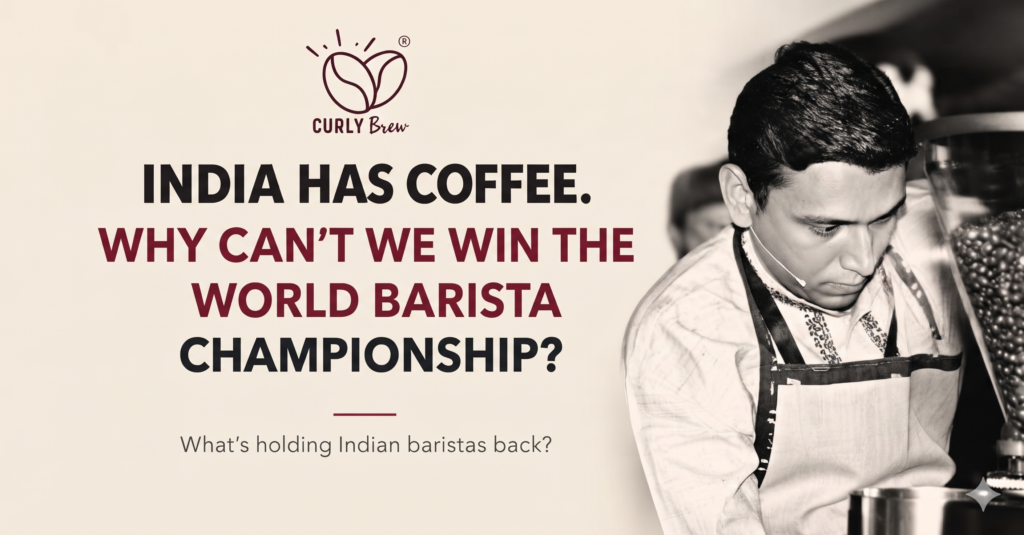
India has coffee, talented baristas and a growing specialty coffee community. Yet reaching the final stage of the World Barista Championship remains a challenge. What needs to change to help Indian baristas compete consistently at the highest level?
When the World Barista Championship (WBC) concluded in Panama in October 2026, Pan Wei of China claimed the title, followed by Shing Win of Malaysia and Frederick Ruben of the United Arab Emirates. The six finalists represented China, Malaysia, the UAE, Australia, Thailand and Canada. India was not among them.
For India, this raises an important question: what will it take for an Indian barista to move beyond participation and compete for a place on the world podium?
India has not been absent from the competition. Suhas Dwarakanath represented the country at the 2025 WBC, reached the semifinals and returned to represent India in 2026. His experience offers an important starting point for a wider discussion about the resources, preparation and industry support required to compete internationally.
The answer is unlikely to lie in one skill, one coffee or one competition result. It calls for a closer look at the ecosystem that supports a barista from the national championship to the world stage.
1. The World Stage Demands More Than a Good Cup of Coffee
The World Barista Championship is a demanding test of technical ability, sensory knowledge, creativity and communication.
Competitors must prepare four espressos, four milk beverages and four signature beverages within 15 minutes. Judges assess several dimensions of the performance, including taste, technical proficiency, cleanliness, creativity and presentation. Each decision matters, from coffee selection and extraction to the way a barista explains the experience in the cup.
A skilled barista working behind a café counter may produce excellent coffee every day. A championship competitor must demonstrate that skill under timed conditions, communicate a coherent concept and deliver a consistent experience across multiple beverages.
This distinction matters.
Developing a competition-ready barista requires more than access to an espresso machine and the opportunity to practise. It calls for structured preparation, repeated sensory evaluation, technical feedback and experience performing under pressure.
India’s challenge, therefore, is not simply to produce talented baristas. It is to build an environment in which that talent can develop and translate into internationally competitive performances.
2. Access to Coffee: An Important Part of the Preparation Gap
Coffee selection is central to a competition performance. Competitors spend considerable time exploring varieties, processing methods, roast profiles and flavour characteristics to identify a coffee that supports their concept.
For Indian competitors, access to a wide range of competition-grade coffees has been identified as a challenge.
In a July 2026 report by Perfect Daily Grind, Suhas Dwarakanath highlighted the difficulties Indian competitors face when sourcing foreign-origin coffees, including import procedures and costs. He also pointed to the financial burden of preparing for international competition.
Limited access can affect how frequently a barista experiments with unfamiliar coffees, compares flavour profiles or tests different approaches to extraction and presentation.
However, the solution should not be to assume that Indian coffee cannot compete globally.
India has diverse coffee-growing regions, distinct growing conditions and producers who continue to experiment with processing and quality. The opportunity is to explore these coffees systematically, understand their potential and help baristas work with exceptional coffees from India and other origins.
Practical steps could include stronger relationships between competitors and producers, collaborative tasting programmes, access to small sample lots, and partnerships that allow baristas to experiment with different coffees throughout the year.
The objective is not simply to find a rare or expensive coffee. It is to develop the knowledge needed to select, understand and present a coffee with precision.
3. Training Must Continue After the National Championship
Winning a national championship is a significant achievement, but it marks the beginning of another demanding phase.
Once selected, a representative must prepare for a competition involving international competitors, specialised judging criteria and an audience of coffee professionals. The transition from national winner to international contender requires time, resources and access to relevant expertise.
A structured preparation programme could make a meaningful difference.
This might include regular sessions on espresso extraction, sensory evaluation, milk texture, signature beverage development, stage presentation and time management. Competitors could also benefit from mock routines assessed against competition score sheets, followed by detailed feedback from experienced judges and trainers.
Sensory training deserves particular attention. A barista must be able not only to identify flavour characteristics but also to describe them accurately and ensure that the beverages delivered match the experience promised to the judges.
International mentorship could add another layer. Experienced competitors, coaches and judges could help national champions understand where their routines are strong, where they need improvement and how their performances align with the demands of the competition.
India already has barista trainers and specialty coffee educators. The opportunity is to connect this expertise through a more coordinated programme that supports competitors throughout their preparation.
4. Who Will Fund the Journey?
Competing at the World Barista Championship involves significant investment in coffee, equipment, coaching and travel. In a 2022 interview with Mid-day, India’s National Barista Champion Mithilesh Vazalwar acknowledged that “neither was the whole process cheap,” highlighting the financial commitment involved in representing India internationally.
The Coffee Board of India already plays a key role in organising the National Barista Championship and developing barista skills. The next opportunity is to build on this foundation by facilitating stronger partnerships between the Board, cafés, roasters, equipment brands and industry associations to support India’s representatives with funding, training and access to resources.
Winning the national title should open the door to the world stage—not leave the champion struggling to finance the journey. Supporting India’s representative must become a shared industry commitment.
5. India Needs a Stronger Development Pipeline, Not Just a Champion
A sustainable competition culture cannot depend on one successful individual. Baristas need opportunities to learn, experiment and improve through regional competitions, workshops, mentorship and regular practice.
Those returning from international competitions can share their experiences with aspiring competitors, trainers and café teams. Reviewing scores, identifying gaps and applying lessons from each competition can help strengthen future preparation. Building on the National Barista Championship with structured post-championship support could help India develop a stronger pipeline of internationally competitive baristas.
6. India’s Coffee Story Can Be a Strength
India has something important to bring to the global coffee conversation: its own coffee-growing heritage, producers, processing practices and evolving specialty coffee scene.
But a compelling origin story alone does not guarantee a strong competition result.
The coffee must taste exceptional, the preparation must be technically sound, and the barista must communicate why the coffee matters. Its story should strengthen the sensory experience rather than replace it.
This is where collaboration across the coffee chain becomes important.
Producers can share their knowledge of growing conditions and processing decisions. Roasters can help competitors understand how those decisions influence flavour. Baristas can use that knowledge to develop beverages and presentations that connect the coffee’s origin to the final cup.
Such collaboration could also create greater visibility for Indian producers, whose work often remains outside the spotlight when attention centres on the competitor standing on stage.
The opportunity is not to rely exclusively on Indian-grown coffee or to assume that foreign-origin coffees are inherently better. It is to give Indian baristas the knowledge and freedom to select the best coffee for their concept and communicate its qualities convincingly.
7. What Needs to Change Next?
There is no single explanation for India’s results at the World Barista Championship. Every competition involves individual decisions, preparation, performance and judging. One result cannot establish that an entire country’s baristas lack skill or potential.
However, the challenges identified by competitors point towards practical areas for improvement.
A stronger pathway could involve five priorities:
Improve access to coffee. Develop industry partnerships that make diverse coffees available for training, experimentation and competition preparation.
Formalise post-championship training. Give national representatives a structured preparation period with mentors, mock competitions and sensory calibration.
Build a sponsorship network. Bring cafés, roasters, equipment brands, producers and other businesses together to share the cost of preparing competitors.
Learn systematically from results. Review scores, identify gaps and carry lessons forward to the next national champion.
Invest in the wider barista community. Create more opportunities for training, regional competition, professional development and knowledge-sharing.
These are starting points, not a complete prescription. They need to be tested and refined with input from baristas, trainers, judges, national competition organisers and industry stakeholders.
The Road to the Podium Begins Before the Competition
The World Barista Championship may last only a few days, but a competitor’s preparation can span months or years.
For India, the next step is to ensure that winning the national championship leads into a well-supported journey towards the international stage. That means combining individual dedication with access to coffee, technical expertise, financial backing and a community committed to learning.
The country already has people working across coffee production, roasting, training, equipment and café culture. Connecting these strengths more effectively could create opportunities for the next generation of baristas.
The objective should not be to judge India’s coffee future by one podium finish. It should be to build a system in which more baristas can develop their skills, represent the country with confidence and compete on merit.
India does not need to wait for a world title to start building that future. The work begins with every barista who trains, every producer who pursues quality, every coach who shares knowledge and every business willing to invest in talent.
Because reaching the world stage is an achievement. Building the support system to compete there consistently is the bigger challenge—and the opportunity ahead for Indian coffee.
What do you think India needs most to compete for the World Barista Championship title—better training, greater industry support, stronger sponsorship, or something else? Share your views in the comments.




The Coffee Board of India already plays an important role in organising the National Barista Championship. Could the next step be a structured post-championship support programme, with training, mentorship and funding, to help our national champion prepare for the world stage? That’s where industry collaboration could make a real difference.
For a barista, winning the national championship is just the beginning. Access to competition-grade coffees, experienced mentors, sensory training and the financial resources to practise consistently can make a huge difference. Talent is essential, but so is the support to develop it.
India has talented baristas, producers and roasters, but how well are we working together? Imagine cafés, coffee brands, equipment companies and producers coming together to support our representatives. Building a strong ecosystem, rather than relying on one individual, could be key to India’s progress on the world stage.